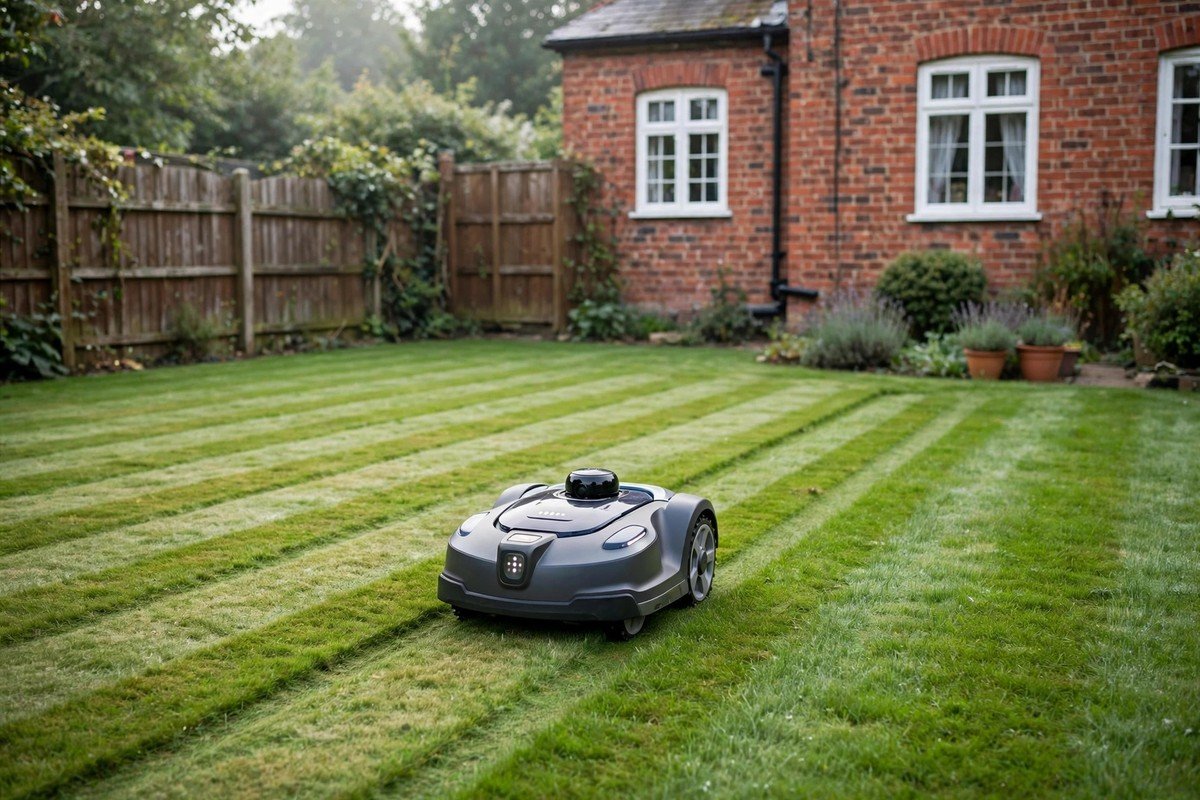
5 Best Robot Lawn Mowers in the UK for a Perfect Garden
- November 10, 2026
- 0
5 Best Robot Lawn Mowers in the UK for a Perfect Garden The best robot lawn mower UK buyers can choose in 2026 depends on three things: the

5 Best Robot Lawn Mowers in the UK for a Perfect Garden The best robot lawn mower UK buyers can choose in 2026 depends on three things: the
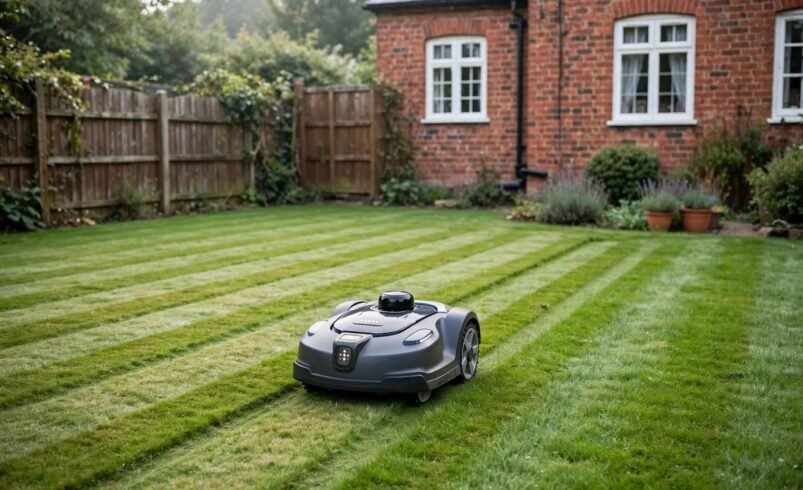
The best robot lawn mower UK buyers can choose in 2026 depends on three things: the size of your lawn, how steep it is, and whether you want to lay a boundary wire. Get those three right and a robot mower will keep your grass neat all season with almost no effort from you. Get them wrong and you end up with an expensive machine that gets stuck, misses patches, or never leaves its dock. This guide compares five current models with verified UK prices and real specifications, so you can pick the right one for your garden the first time.
Robot mowers have changed fast in the last two years. The old models all needed a boundary cable pegged around the lawn. The new wire-free models navigate by satellite positioning, LiDAR, or cameras, and you set them up by walking the boundary once with an app. If you already trust a robot to clean your floors, our guide to the best AI robot vacuum shows how the same navigation technology works indoors. Outdoors, the stakes are higher, because rain, slopes, and tree cover all affect how well the mower works.
We opened the top five ranking guides live and compared what they actually cover, then checked every price and specification in this article against a live source on 10 November 2026. Prices move fast in autumn as retailers clear stock, so every price below is dated. We picked one model for each common UK garden: a small typical garden, a medium garden on a budget, a garden under heavy tree cover, a larger garden, and a steep or rough garden. Gardeners’ World tested seven models on real UK lawns and gave the Mammotion Luba mini 2 its only 5-star rating in the category, which matches our own shortlist.
We also fixed the gaps the top guides leave open. None of them explains UK winter storage, almost none covers hedgehog safety, and none gives a real running-cost breakdown. Those sections are in this guide, with brand-specific advice rather than generic tips.
| Model | UK price | Max lawn | Navigation | Boundary | Max slope | Rain handling |
|---|---|---|---|---|---|---|
| WORX Landroid Vision Cloud WR303E | About £630, RRP £699.99 | 300 m² | RTK Cloud + Vision AI | Wire-free | 30% (17°) | Rain sensor, 180-minute delay |
| Ecovacs GOAT O600 RTK | RRP £449 | 600 m² | RTK + AI camera | Wire-free | 45% (24°) | Rain sensor, returns to dock |
| Husqvarna Automower 305 | RRP £1,099 | 600 m² | Boundary wire | Wire | 40% inside, 15% at edge | No rain sensor, mows in rain |
| Segway Navimow i208 LiDAR | £1,099 | 800 m² | LiDAR + vision | Wire-free | 45% (24°) | No rain sensor, forecast scheduling |
| Mammotion Luba mini 2 AWD 1000 | RRP £1,399 | 1,000 m² | NetRTK + triple-camera vision | Wire-free | 80% (38.6°) | Rain sensor, pauses in rain |
The WR303E is the best robot lawn mower in the UK for a typical back garden, and the one we would fit most often. It covers lawns up to 300 m², which covers most British back lawns, and it costs about £630 at UK retailers against an RRP of £699.99. There is no wire to bury and no antenna to mount. Positioning comes from WORX RTK Cloud, which corrects the mower’s location over the internet, backed up by Vision AI and V-SLAM when satellite view drops under trees or in shade.
Setup is app-led and takes under an hour on a straightforward plot. It cuts an 18 cm width at 30 to 60 mm across four cutting heights, runs on a 20V PowerShare battery shared with other WORX garden tools, and handles a 30% slope. The rain sensor sends it back to the dock when rain starts, then waits 180 minutes by default after the sensor dries before resuming. The three pivoting blades are the safer design for wildlife, and the mower is rated IP66, so you can hose it clean.
Know the limits before you buy. Cutting height is set by hand on the machine, not through the app, and a true zero-edge cut needs an optional module, so expect to trim a narrow strip by hand without it. The 30% slope rating rules out any garden with a proper bank. The mower also needs stable Wi-Fi at the charging station, so check your signal reaches the dock spot before you order. WORX after-sales takes steady criticism on Trustpilot over response times and parts availability, which matters on a machine you expect to last years.
The GOAT O600 RTK is the best value robot mower in this guide, and the cheapest way to get a properly wire-free machine that covers a medium garden. At an RRP of £449 it covers up to 600 m², double the WORX, with a 19 cm cutting width and a cutting height adjustable from 30 to 80 mm in 0.5 cm steps. That taller maximum height is genuinely useful in spring, when grass grows fast and a low maximum cut forces you to mow with a normal mower first.
Navigation uses TrueMapping 2.0, a multi-fusion RTK system that receives signals from up to 45 satellites, plus an AI camera that recognises more than 200 common garden obstacle types, including hedgehogs. The slope rating is 45% (24°), the body is IPX6 waterproof, and the rain sensor pauses mowing and returns the mower to its charging station, resuming by default 3 hours after the rain stops. Its TruEdge system cuts close to boundaries, and it can cross paths as narrow as 0.7 m, which helps on gardens split into sections.
The trade-off is the RTK reference station, a small antenna unit that sits in the garden and gives the mower its centimetre-level position. It needs a clear view of the sky, so a garden under heavy tree cover is a weaker fit than for a wire model. The 19 cm deck is also narrow, so a 600 m² lawn takes longer to finish than it would with a wider machine. Even so, at £449 with a rain sensor, hedgehog recognition, and a 3-year warranty, nothing else in this guide matches it for value.
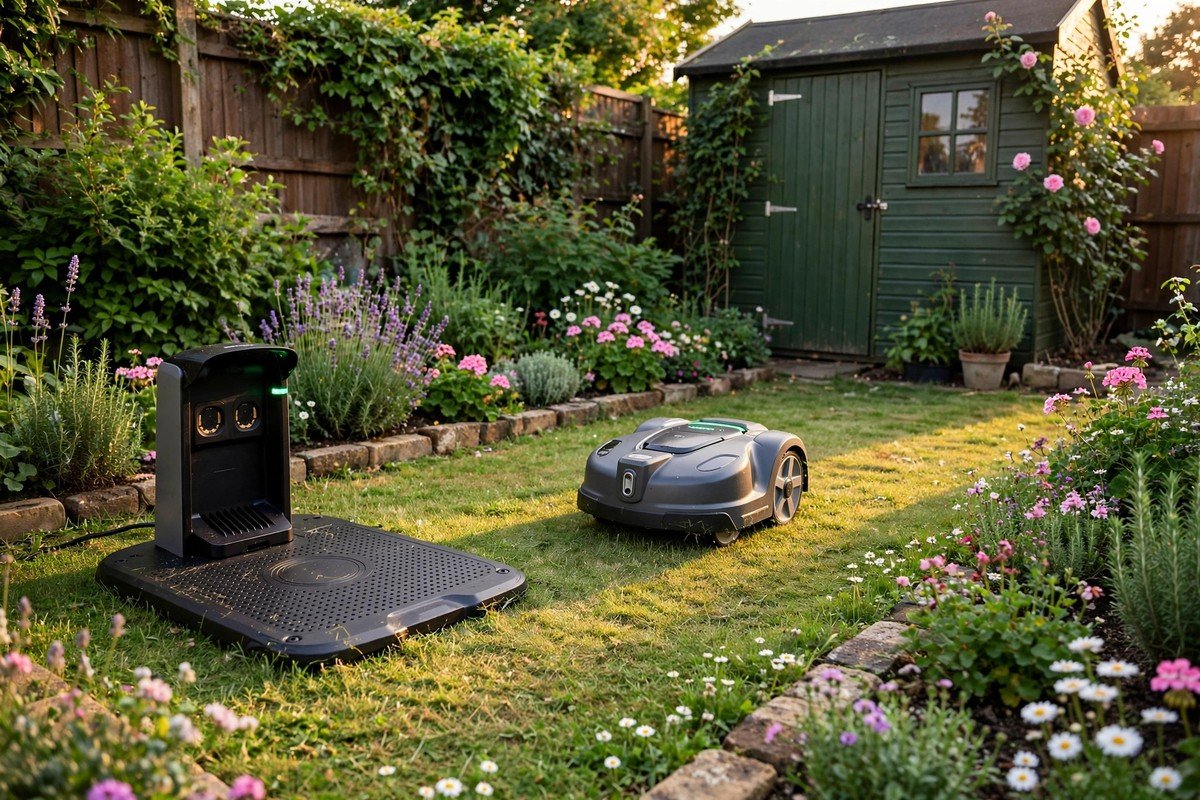
The Automower 305 is the pick for gardens where wire-free models struggle: heavy tree canopy, patchy Wi-Fi at the bottom of the garden, or a large detached outbuilding blocking the signal. A boundary wire does not care about tree cover, cloud, or Wi-Fi. Husqvarna invented this category, and the 305 is the right size for the average UK back garden at 600 m², with a 40% slope rating inside the lawn and 15% at the boundary. The RRP is £1,099, and dealer prices vary, so check before ordering.
It cuts a 22 cm width at 20 to 50 mm with three pivoting razor blades, and it mows for about 60 minutes per charge. Two features set it apart from the wire-free models. The weather timer adjusts mowing time to the grass growth rate, so it works harder in spring and eases off in dry weather. The frost guard pauses the schedule automatically when temperatures drop, which protects the lawn from damage. The mower is weatherproof and keeps mowing in rain, though the manual is honest that wet grass clumps and sticks, so the best results still come in dry weather.
The cost is the installation. Budget half a day to peg or bury the cable, and expect to spend longer on a complex garden with island beds and paths. Changing a border later means lifting and re-pegging the wire. The mower also navigates randomly rather than in systematic stripes, so it needs longer on the lawn to cover it, and replacement blades are needed every 4 to 8 weeks on average according to Husqvarna. What you get in return is the most mature firmware in the category and a UK dealer network for servicing and spare parts, which Husqvarna says are often available for up to 10 years after a model is discontinued.
The Navimow i208 LiDAR is the quietest route to a wire-free mower for a larger garden. It covers up to 800 m², uses solid-state LiDAR plus a vision camera, and needs no boundary wire, no RTK antenna, and no satellite fix. That last point matters: because it navigates by LiDAR, it keeps working under trees and at night, where satellite models can lose their position. It costs £1,099, handles a 45% (24°) slope, cuts a 22 cm width at 20 to 70 mm, and runs at 59 dB, about the sound of a microwave.
The battery is a 5.1 Ah unit with a 110-minute runtime per charge and about 265 m² covered per charge, so an 800 m² lawn takes several sessions with charging breaks in between. That is normal for robot mowers, but it means a large lawn is finished over a day or two rather than in one run. The body is IP66 rated, so rain itself is not a problem, and you can clean it with a hose.
There is one real weakness to know about. The i2 LiDAR series has no physical rain sensor. It uses weather-forecast scheduling in the app instead, so a surprise shower will not send it home the way a mower with a real rain sensor would. If you want it to stay out of the rain, set the forecast-based schedule and accept that it will sometimes mow in drizzle. For a flat to gently sloping garden up to 800 m² where quiet running matters, for example a terraced street, it is still the best fit in this guide.
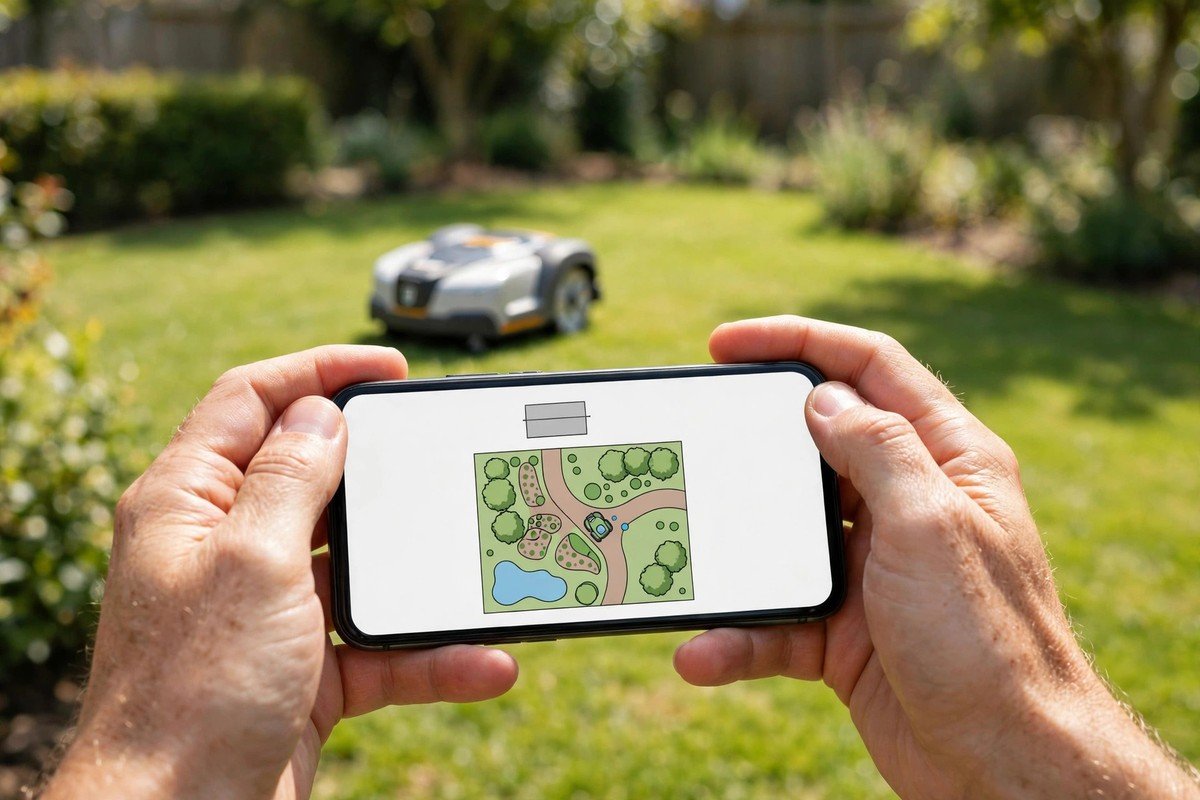
The Luba mini 2 AWD 1000 is the mower for gardens the others cannot handle. All-wheel drive takes it up slopes of 80% (38.6°), far beyond any two-wheel-drive model here, and it covers up to 1,000 m². The RRP is £1,399, and Gardeners’ World gave it 5 stars, the highest rating in its 2026 test, calling it the best robot mower for bumpy or hilly ground.
Navigation combines NetRTK satellite corrections with a triple-camera AI vision system, so there is no wire and no antenna to install in the garden. It cuts a 20 cm main deck plus a separate 12 cm edge disc, which trims to within about 2.5 cm of walls and paving and almost removes the need for manual edging. Cutting height runs from 20 to 65 mm and is app-controlled. The 6.1 Ah battery gives up to 150 minutes per charge, the body is IPX6 rated, and the rain sensor pauses work when rain starts. The app also includes settings for rain and wildlife protection.
Two things to weigh. The 20 cm main deck is narrow for a 1,000 m² lawn, so full coverage takes several charging cycles spread across the week on a large garden. And at £1,399 it costs more than three times the GOAT O600, so it only makes sense if your garden actually needs the slope handling or the area. If your lawn is steep, rough, or split across levels, nothing else in this guide will cope with it. If your lawn is flat, save the money and buy the WORX or the Ecovacs.
Choose wire-free if your garden is awkwardly shaped, you move borders around, or you want to unbox and mow the same day. Wire-free setup takes 20 to 60 minutes of app work against half a day pegging cable, and changing a zone later takes seconds on your phone. Wire-free models in this guide cost from £449 to £1,399, and none of the five needs a paid subscription for core navigation: WORX RTK Cloud corrections and Segway Network RTK are both included at no extra cost.
Choose a boundary wire if your garden works against wire-free navigation. Heavy tree canopy, a large outbuilding, or patchy Wi-Fi at the far end of the lawn are all situations where a physical wire is still more reliable. The wire also keeps working when the app, the cloud, or the satellite signal has a bad day. The price bands tell the same story: boundary-cable models in this category run about £500 to £2,000, while wire-free models run about £900 to £3,500 at the top end, though the GOAT O600 at £449 breaks that pattern. The navigation technology in these mowers is the same family of sensors that guides how warehouse robots work, and the difference between the two approaches is really about which weakness you would rather live with.
Follow these six steps on the day the mower arrives, and it will be cutting the same afternoon.
First, pick the dock spot. It needs flat ground near an outdoor socket, a clear view of the sky for RTK models, and Wi-Fi that reaches it. Walk to the far end of the garden with your phone and check the signal there too, because some models need Wi-Fi across the whole lawn, not just at the house.
Second, charge the mower fully and update the app and firmware before you map anything. Third, cut the grass with a normal mower first if it is long. Robot mowers trim a few millimetres at a time, and a mower with a 30 mm minimum height cannot rescue a lawn that has grown to 100 mm.
Fourth, walk the boundary with the app open, or let the mower auto-map if your model supports it. Add no-go zones around flower beds, the pond, the trampoline, and anywhere the mower could get stuck. Fifth, set a little-and-often schedule, three to four sessions a week, so the mower takes a thin cut each time and the clippings mulch back into the lawn. Sixth, watch the first full run. Move anything it bumps into, widen any passage it cannot enter, and adjust the boundary where it leaves a strip uncut.
If you chose a boundary-wire model instead, the job is different: peg or bury the cable around the lawn edge and every obstacle, which takes most of a day on a medium garden. A typical garden needs about 130 m of cable. The wire then stays in the ground for years, and you only lift it when you reshape a border.
Running costs are small, but they are not zero, and no top-five guide totals them honestly. Electricity is the smallest part. One guide estimates roughly £15 to £35 a year for the average UK lawn, and Husqvarna’s own manual puts the Automower 305 at a mean 5 kWh a month at maximum use on a 600 m² lawn, which is 60 kWh a year. Blades are the real consumable. Expect about £8 to £20 for a set every 8 to 12 weeks of use, and Husqvarna puts average pivoting blade life at 4 to 8 weeks depending on grass condition, so budget for several sets a season if you mow from March to October.
Subscriptions are the cost to check before you buy. None of the five models in this guide needs a paid subscription for core navigation, but that is not true of every robot mower on the market, and some brands charge for 4G connectivity or cloud features after an included period. Ask the seller what stops working if you never pay, and get the answer in writing. A boundary-wire model has one extra long-term cost: the cable lasts about 5 to 8 years before sections need replacing, and a dealer service costs around £180 for a Husqvarna, according to one review.
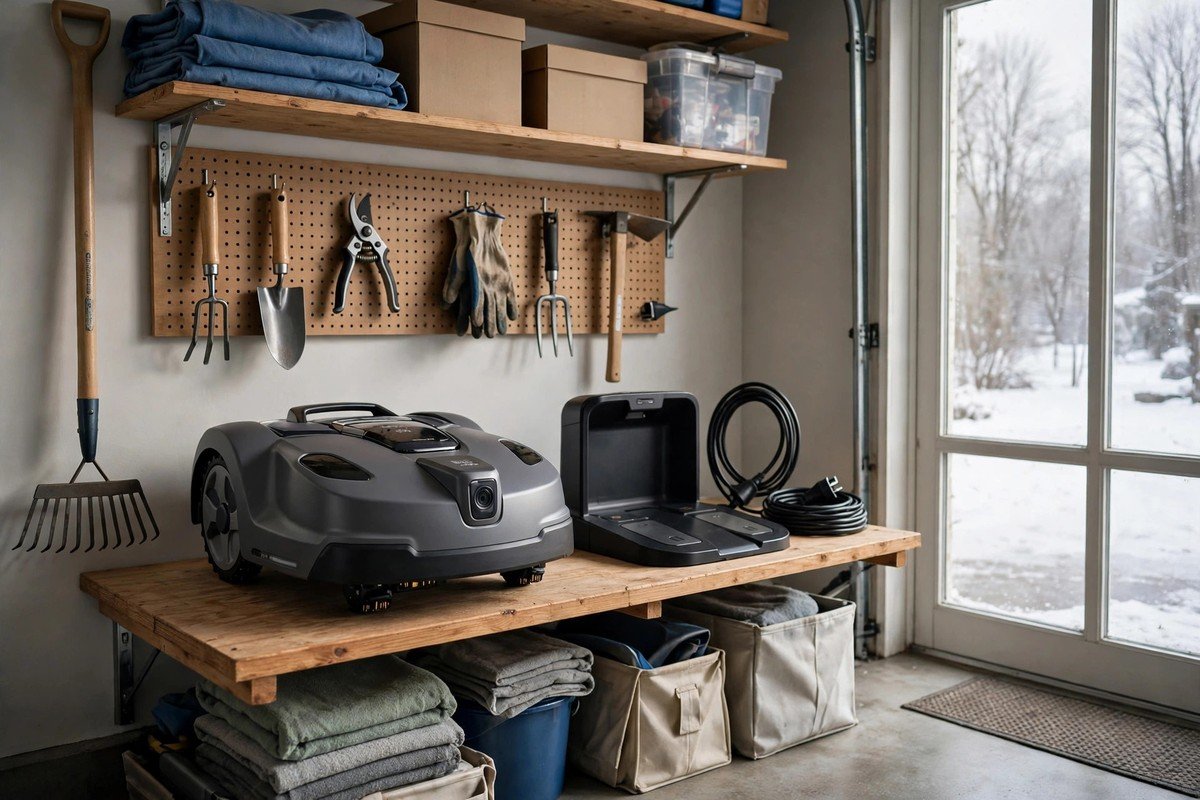
UK grass stops growing in late autumn, and that is when the mower needs to come inside. Stop mowing about a week before the first frost, or when daytime temperatures stay below 4 to 10°C. Before the last cut, raise the cutting height, Husqvarna suggests leaving 6 to 8 cm, so the grass goes into dormancy a little longer and survives winter better.
Clean the mower and the charging station properly first: chassis, wheels, blade disc, and charging contacts. Then charge to your brand’s target, which is where the brands disagree. Husqvarna says fully charge the Automower and switch it off before storage, and most current models need no mid-winter top-up. Worx also says fully charged, with a recharge every two months during storage. Segway Navimow specifies at least 85% charge and prefers its hibernation mode. Mammotion specifies about 80% charge, with a recharge at least every 90 days. Never store a mower with a flat battery: cold speeds up discharge, and a fully empty lithium battery can be damaged.
Store the mower indoors in a dry, frost-free space that stays above 0°C, such as a garage or shed. A heated space between 10 and 20°C is better for long-term battery health. Bring the charging station indoors where the manual advises it, and leave the boundary wire in the ground with the wire ends protected by a coupler or grease. RTK and EPOS antennas can usually stay outside, subject to their temperature limits, but check your model’s manual rather than assuming.
Hedgehogs are the real wildlife concern, because they are nocturnal and their defence is to curl into a ball rather than run. The simplest protection is free: run the mower during the day and never schedule it after dusk. Camera-based models add a second layer. The Ecovacs GOAT O600 AI camera is trained to recognise hedgehogs among the 200-plus obstacle types it identifies, and WORX builds a “Save the hedgehogs” mode into its wired Landroid models.
Blade design matters too. All five models here use small pivoting razor blades on a disc rather than a heavy fixed blade, and the WORX and Husqvarna models add a skid plate that helps the mower ride over rather than cut into anything soft on the ground. Modern mowers also carry lift, tilt, and bump sensors that stop the blade quickly when the deck is lifted. Even so, no sensor is perfect, so clear the lawn of toys, tools, and pet waste before a run, and keep the mower on a daytime schedule.
For pets, the same daytime rule applies, and the obstacle cameras on the wire-free models are good at spotting dogs and cats. If your garden is a smart home already, our guide to the best AI smart home devices for beginners covers the cameras and sensors that pair well with a robot mower schedule.
Buy the WORX Landroid Vision Cloud WR303E if you have a typical UK garden under 300 m² and want the easiest wire-free setup at a fair price. Buy the Ecovacs GOAT O600 RTK if you want the best value: £449 for 600 m² of coverage, a rain sensor, and hedgehog recognition is unmatched in this guide. Buy the Husqvarna Automower 305 if your garden has heavy tree cover or patchy Wi-Fi, and you want the reliability of a wire and a dealer network behind it. Buy the Segway Navimow i208 LiDAR if your lawn runs to 800 m² and you want quiet LiDAR navigation that works under trees and at night. Buy the Mammotion Luba mini 2 AWD 1000 if your garden is steep, rough, or up to 1,000 m², and nothing else will cope with it.
Robot mowers are the most useful home robots you can buy today, ahead of the humanoid robots you can actually buy, because they do a real weekly job rather than a party trick. Measure your lawn, check your slope, and check your Wi-Fi before you order. Those three checks decide which of these five is right for you.
The best robot lawn mower UK gardens need in 2026 is the one matched to the garden, not the most expensive one. The WORX WR303E suits the typical British back garden, the Ecovacs GOAT O600 is the value pick for medium lawns, the Husqvarna Automower 305 is the reliable wire option under trees, the Segway Navimow i208 covers larger lawns quietly, and the Mammotion Luba mini 2 handles slopes and rough ground nothing else in this guide can. Check the price on the day you buy, install it with the six steps above, and store it properly over winter with the right charge level for your brand. Do that, and the mower will give you back your Saturday mornings for years.
No, not any more. Wire-free models use RTK satellite positioning, LiDAR, or cameras to follow virtual boundaries you draw in an app, and four of the five models in this guide work that way. A boundary wire is still the safer choice under heavy tree canopy or with patchy Wi-Fi, because the wire does not depend on a signal at all.
Yes, if you buy enough slope rating. Most domestic models handle 25 to 35% gradients, the WORX WR303E manages 30%, and the Segway Navimow i208 and Ecovacs GOAT O600 both manage 45%. For a proper bank, buy all-wheel drive: the Mammotion Luba mini 2 AWD handles 80% slopes. Always check the boundary slope figure too, because makers allow far less slope at the lawn edge than inside it.
Most of them do, but they handle it differently. The Ecovacs GOAT O600, WORX WR303E, and Mammotion Luba mini 2 all have rain sensors that pause mowing and return the mower to its dock. The Segway Navimow i208 has no physical rain sensor and relies on weather-forecast scheduling instead. The Husqvarna Automower 305 has no rain sensor either, but it is weatherproof and keeps mowing in rain, though wet grass clumps and the cut is better in dry weather.
Clean the mower and charging station, charge to your brand’s target, switch it off, and store it indoors somewhere dry and frost-free above 0°C. Husqvarna and Worx say fully charge it, Segway Navimow says at least 85%, and Mammotion says about 80% with a recharge at least every 90 days. Leave the boundary wire in the ground with the ends protected, and bring the charging station indoors where the manual advises it.
For a garden under 300 m², the WORX Landroid Vision Cloud WR303E at about £630 is the best pick, because it needs no wire and no antenna and sets up in under an hour. If your small garden is closer to 500 m² or you want the lowest price, the Ecovacs GOAT O600 RTK at an RRP of £449 covers more lawn for less money, with a rain sensor and hedgehog recognition included.