How Warehouse Robots Work: Inside Amazon’s Automated Warehouses
How warehouse robots work inside Amazon warehouses is best understood by following one order, not by looking at one machine. When you click buy, software finds your item, a mobile robot brings the shelf to a worker, a picking arm or a human hand takes the item out, and sorters route the parcel toward the right truck. No single robot does the whole job. The system works because each robot does one stage well and a central system coordinates them all.
That coordination is the real story. Amazon passed one million robots deployed across its fulfilment network in 2025, roughly one robot for every worker, according to the competitor research for this article. At that scale, the hard problem is no longer building a robot that can move. It is running thousands of robots in one building without collisions, delays or lost stock, hour after hour, including through a holiday peak.
How Warehouse Robots Work: The Order Journey in 6 Stages
| Stage |
What happens |
Who or what does it |
| 1. Receiving |
Stock arrives, is checked and registered in the system |
Workers plus warehouse software |
| 2. Stowing |
Items are put away on mobile shelving pods |
Mobile robots carry pods to stowers |
| 3. Picking |
Your order triggers a pod delivery to a picking station |
Mobile robots, workers, picking arms |
| 4. Packing |
Items are boxed in the right sized box |
Workers with software sized packaging |
| 5. Sorting |
Parcels are routed to the right truck or lane |
Sortation systems such as Cardinal |
| 6. Shipping |
Parcels are loaded onto outbound trucks |
Workers, conveyors and sorters |
The Robots That Move the Shelves: Mobile Robots and Pods
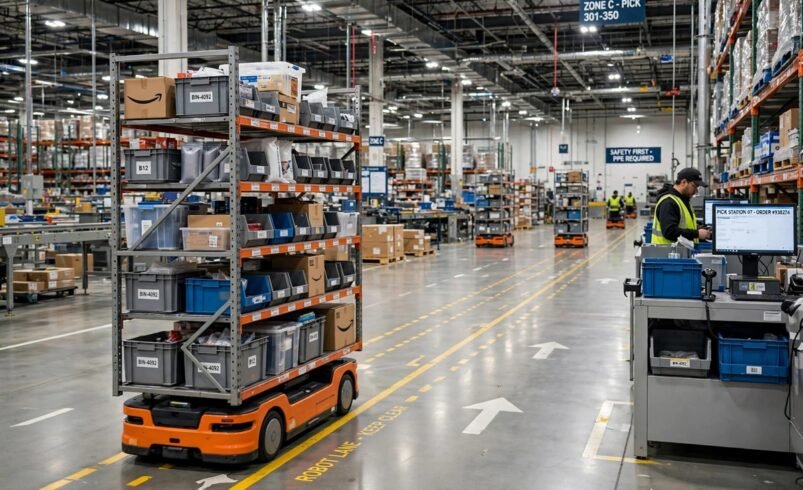
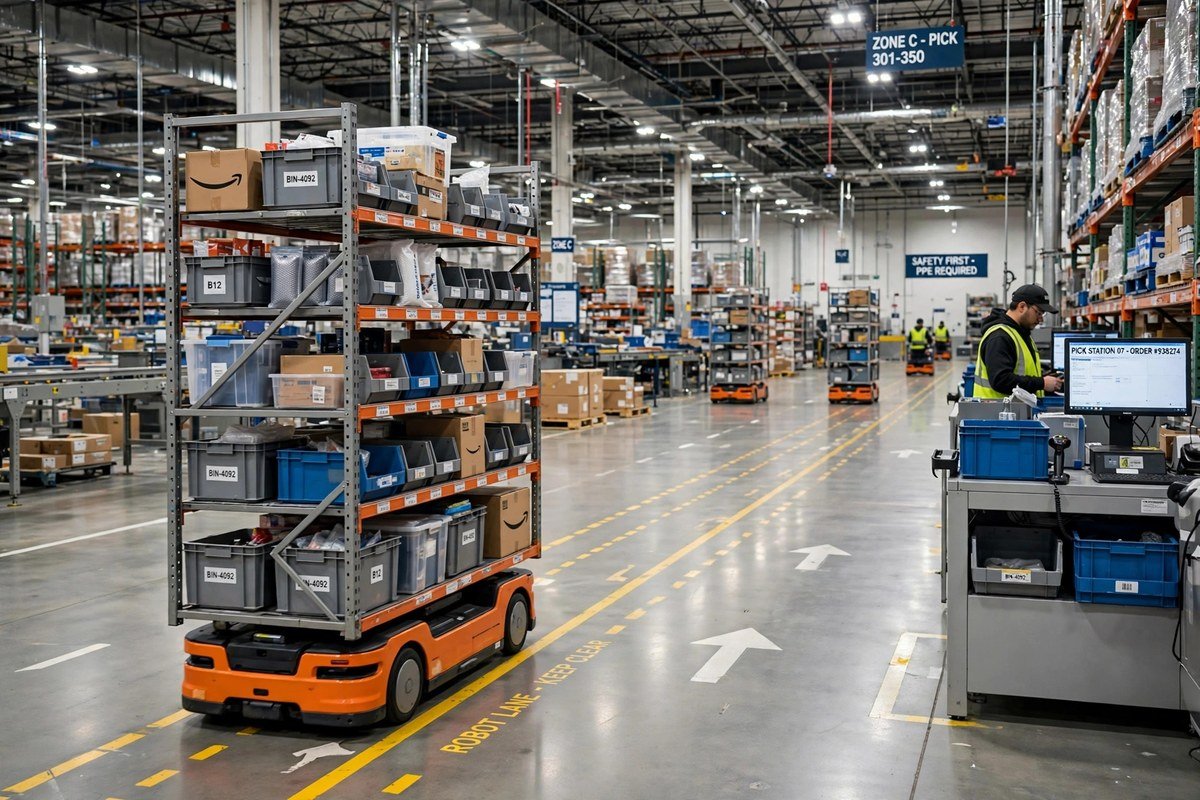
The story starts in 2012, when Amazon bought Kiva Systems, a company that had redesigned warehouse shelving into standard, portable units called pods. A low, flat robot slides underneath a pod, lifts it off the floor and carries the whole shelf to a worker, instead of the worker walking to the shelf. That single flip, goods to person instead of person to goods, is still the foundation of Amazon’s warehouses.
Amazon’s later drive units, such as Hercules, work the same way at larger scale. Hackaday’s summary of Amazon’s Hercules robot explains that Hercules scoots under a four sided pod, lifts it and moves it across a floor marked with a grid of navigation markers. A depth sensing camera helps it navigate, and it can sense nearby robots and workers wearing connected vests, even outside its line of sight. To change direction it sets the pod down, turns, and picks the pod back up again, rather than rotating the shelf itself.
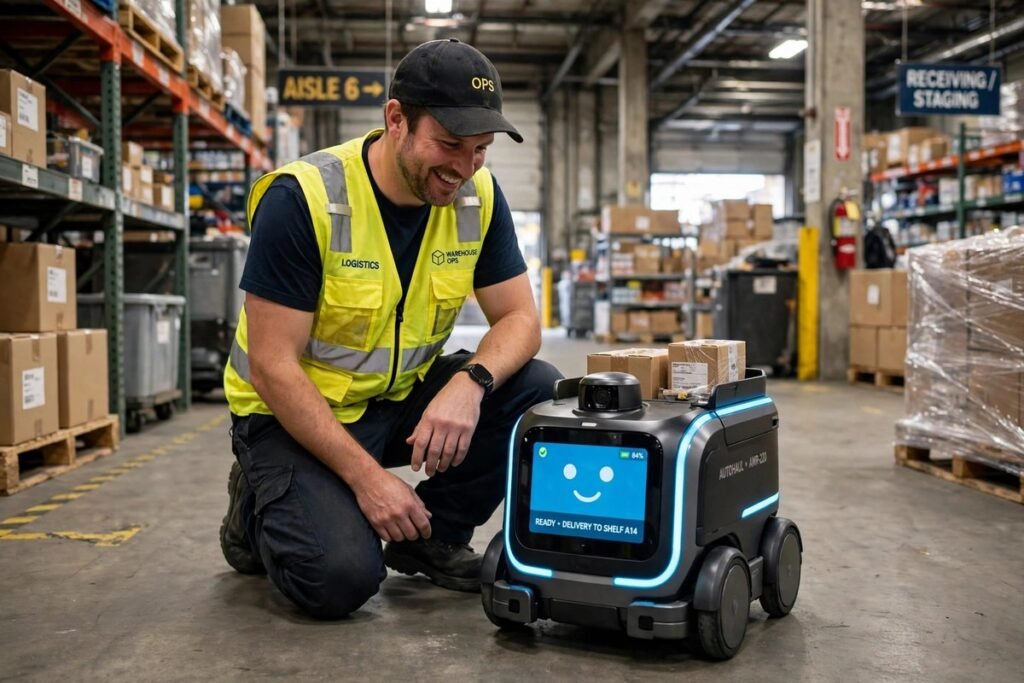
Amazon’s Proteus takes the idea one step further. Unlike the early Kiva robots, which worked in a fenced off zone that people never entered, Proteus is fully autonomous and moves among people on the open floor. That matters because it removes the hard barrier between the robot area and the human area, and it shows how far safety sensing has come: the robot must be trusted to stop, wait and route around people on its own.
How the Robots Navigate Without Crashing
Navigation is a team problem, not a solo skill. Each mobile robot knows where it is from the floor markers and its own sensors, but a central system decides which robot goes where, in what order, and along which route. Robots wait at virtual intersections the way cars wait at junctions, so hundreds of them can share the same floor without gridlock.
This is also why the layout of an Amazon warehouse looks strange to a human. Shelves do not need to sit in neat rows sorted by category, and they do not need walking space between every unit, because people are not walking the aisles. Items are stowed wherever they physically fit, a method often called chaotic storage, and the software remembers exactly where everything is. The result is denser storage and faster retrieval, at the cost of total dependence on the system knowing the truth about every location.
That dependence explains the quietest robots in the building: the inspection and inventory robots. Some move through aisles scanning shelves, while others monitor stock levels and flag items that are missing or misplaced before they turn into a delayed order. If the system believes an item is somewhere it is not, every later step fails, so keeping the inventory record accurate is what keeps the picking and sorting robots useful. The same on device intelligence idea appears in our guide to what edge AI is and why it matters: sensing and deciding locally, close to where the work happens, rather than waiting on a distant server for every move.
The Arms That Pick: Sparrow, Robin and the Grasping Problem
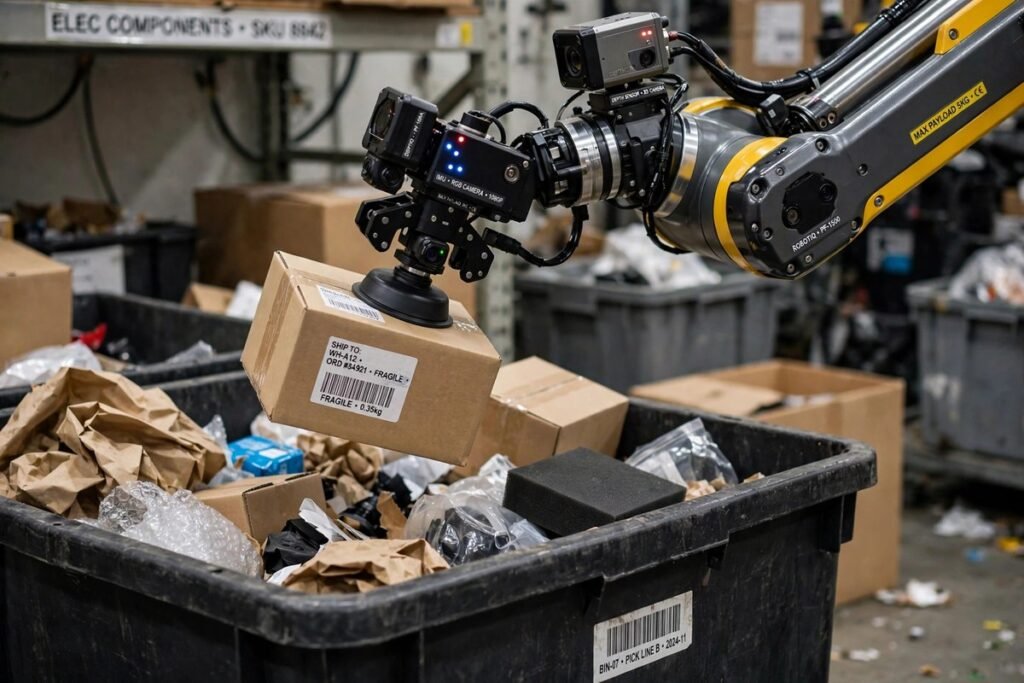
Moving a shelf is the easy half of the job. Taking the right item out of a mixed bin is much harder, and that is where robotic arms come in. Amazon’s Sparrow arm uses cameras and computer vision to identify a specific product, work out how to grasp it without damaging it, and place it into a tote for the next stage. Robin handles a related job, sorting and moving items at other points in the flow.
Grasping is hard because no two items behave alike. A book, a bottle, a soft toy and a bag of coffee have different shapes, weights and fragility, and they sit jumbled together in a bin. The arm must see the item, judge which grip will hold it, and handle failure gracefully when a grip slips. That is why picking is still shared work in most facilities: robots take the items they can grasp reliably, and people handle the awkward exceptions, damaged packaging and judgement calls. For the same reason, a warehouse arm is not a general purpose hand. It is a specialist, and the specialist framing matters: our guide to the best laptops for AI developers in 2026 makes a similar point about AI hardware, where a specialist chip only helps the workloads it was built for.
Sorting, Packing and the Last Check Before the Truck
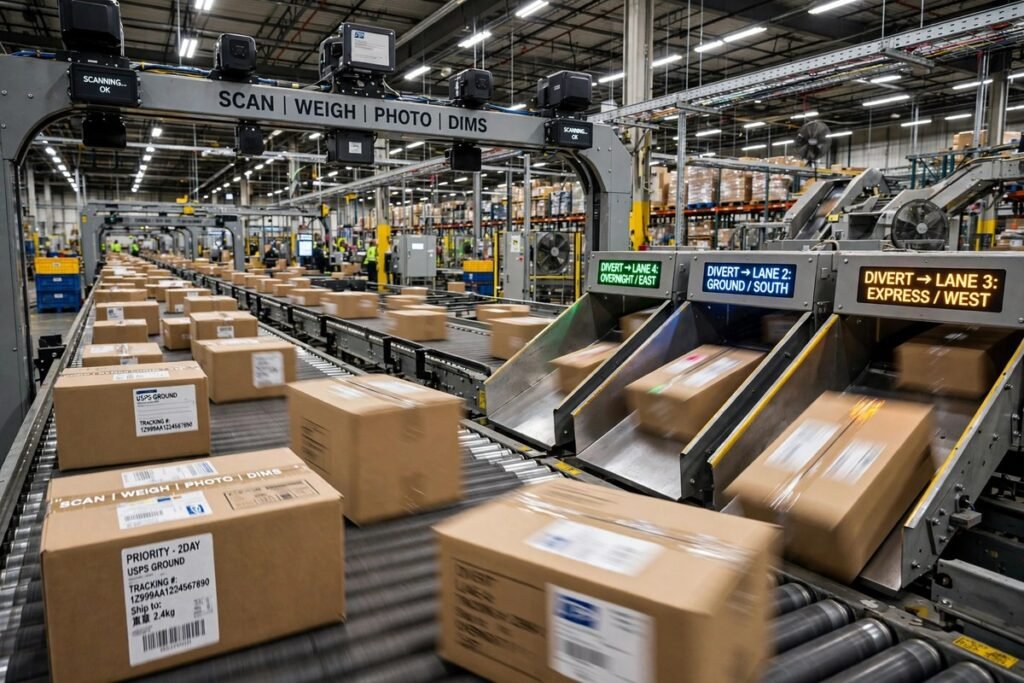
Once items are picked, they travel on conveyors toward packing, where software calculates the right box size for the order so parcels ship with less wasted air and material. Then sortation takes over. Systems such as Cardinal scan each parcel, read its destination and route it toward the correct truck, chute or delivery lane, thousands of times an hour at peak volume. That speed and consistency is what manual sorting cannot match, and it is what keeps the right box heading to the right doorstep.
The final automated checkpoint is a quality gate. In the SLAM process, which stands for Scan, Label, Apply, Manifest, a sealed box is scanned and weighed as it moves down the belt. If the actual weight differs from the expected weight of the ordered items, the box is pulled off the belt for inspection. If it passes, a label is applied and the parcel is manifested for its truck. It is a simple idea, but it catches wrong items and missing items before they reach a customer, which is far cheaper than fixing the mistake after delivery.
What the Robots Do Not Do
Three limits are worth stating plainly, because competitors gloss over them. First, robots do not pack boxes on their own in the general case. Packing still leans heavily on people, with software choosing box sizes and robots handling movement and sorting around them. Second, robots do not replace warehouse workers one for one. They replace repetitive trips, lifts, scans and sorts, while people increasingly handle exceptions, quality judgement, maintenance and oversight. Third, the system is only as good as its software and its inventory data. A robot fleet with a wrong stock record will fetch the wrong pod very efficiently.
There is also a cost and complexity limit that smaller warehouses feel first. Integrating robots means changing floors, racking, software and working practices at the same time, and maintaining a large fleet is its own job. Amazon can absorb that because of its scale. A small warehouse usually starts with one stage, often sorting or a few mobile robots, rather than rebuilding the whole building at once.
What Comes Next: Humanoids and Smarter Fleets
The next step competitors mention, and Amazon is testing, is humanoid robots for tasks that need a human shaped body, such as reaching high shelves or handling items in spaces built for people. Humanoids are still early compared with pods and arms, and they are best read as an experiment in covering the jobs that wheeled robots cannot reach, not as a replacement for the whole system.
The more important trend is quieter: better fleet coordination, better grasping and more testing in simulation before robots touch a real floor. Developers now rehearse navigation, grasping and fleet behaviour in virtual warehouses, where a mistake costs nothing, and only then deploy the tested behaviour to real machines. Expect warehouses to look more coordinated rather than more robotic: the same machines, sequenced better, with people supervising the exceptions.
For readers thinking about automation in their own work, the lesson transfers beyond warehouses. Start from the repetitive journey, not the flashiest machine, and check whether your data is accurate enough for automation to trust. Our guide to running AI models locally vs in the cloud applies the same test to AI tools, and our guide on whether an AI PC is worth buying in 2026 warns against buying a badge instead of a capability. The warehouse version of that warning is simple: buy the system that fits your volume, not the robot that looks best in a video.
Conclusion
How warehouse robots work at Amazon comes down to a division of labour. Mobile robots bring shelves to people, arms pick what they can grasp, sorters route parcels, inspection robots keep the stock record honest, and central software coordinates the whole flow from order to truck. The one million robot milestone matters less than what it proves: that the system, not any single machine, is the technology. Understand the journey, the navigation and the limits, and the automated warehouse stops looking like magic and starts looking like good engineering.
Frequently Asked Questions
How do warehouse robots work at Amazon?
They work as a coordinated system. Mobile robots carry shelving pods to picking stations, robotic arms such as Sparrow pick items from bins, sortation systems route parcels to the right truck, and central software sequences every move from order to shipping.
What types of robots does Amazon use in its warehouses?
The main types are mobile drive units that move pods, including Proteus and Hercules, robotic picking arms such as Sparrow and Robin, sortation systems such as Cardinal, and inspection robots that scan shelves and track inventory accuracy.
How many robots does Amazon have?
Amazon passed one million robots deployed across its fulfilment network in 2025, roughly one robot for every worker. Earlier reporting put the figure above 750,000, so the fleet has grown substantially in a short time.
Do Amazon warehouse robots replace human workers?
Not one for one. Robots take over repetitive trips, lifts, scans and sorts, while people handle exceptions, quality judgement, maintenance and oversight. The mix of jobs changes, but packing, problem solving and supervision still need people.
What is chaotic storage in an Amazon warehouse?
It is the practice of stowing items wherever they physically fit, rather than grouping them by category in fixed aisles. Software tracks every item’s exact location, so a pod can hold unrelated products and still be retrieved quickly when an order needs one of them.